
What is Digital Marketing ? A Simple Guide for Beginners.
If you ask five different people to define digital marketing, you might get five different answers. One might say it is about posting videos on Instagram. Another might describe it as running Google advertisements, while someone else may think it is simply sending promotional emails.
The truth? Digital marketing includes all these activities and much more.
In simple terms, digital marketing is the process of promoting products, services, or brands using the internet and digital technologies to connect with potential customers.
Today, people search Google before making purchases, compare products on social media, watch YouTube reviews, and receive promotional emails. Businesses need to be present where their customers spend time.
That is where digital marketing comes in. Whether you run a small business, manage a brand, or are exploring marketing as a career, understanding digital marketing is an important first step.
Table of Contents
- What Is Digital Marketing?
Digital marketing refers to all marketing activities carried out through digital channels such as websites, search engines, social media platforms, email, and online advertising networks.
Unlike traditional marketing, which often communicates with a broad audience, digital marketing allows businesses to reach specific groups of people based on their interests, location, behaviour, and needs.
For example:
Imagine you own a small bakery in Kerala.
You could:
- Create an Instagram page to showcase your cakes.
- Optimise your website so customers searching for “best bakery near me” can find you.
- Run Facebook advertisements targeting people in your local area.
- Send special offers to customers through email.
All these activities are examples of digital marketing.
- Traditional Marketing vs Digital Marketing
Think of traditional marketing as standing in a crowded marketplace with a megaphone, announcing your product and hoping the right people hear you.
Digital marketing is more like having a direct conversation with someone who is already interested in what you offer.
Both approaches have their place, but digital marketing provides businesses with greater opportunities to target audiences, measure results, and adjust campaigns.
| Traditional Marketing | Digital Marketing |
|---|---|
|
Newspapers and magazines |
Websites and blogs |
|
Television commercials |
YouTube advertisements |
|
Roadside billboards |
Social media campaigns |
|
Printed brochures |
Email newsletters |
|
Radio advertisements |
Podcasts and digital audio ads |
- The Four Core Pillars of Digital Marketing
Digital marketing has several specialised areas, but four important pillars provide a good foundation for understanding how online marketing works.
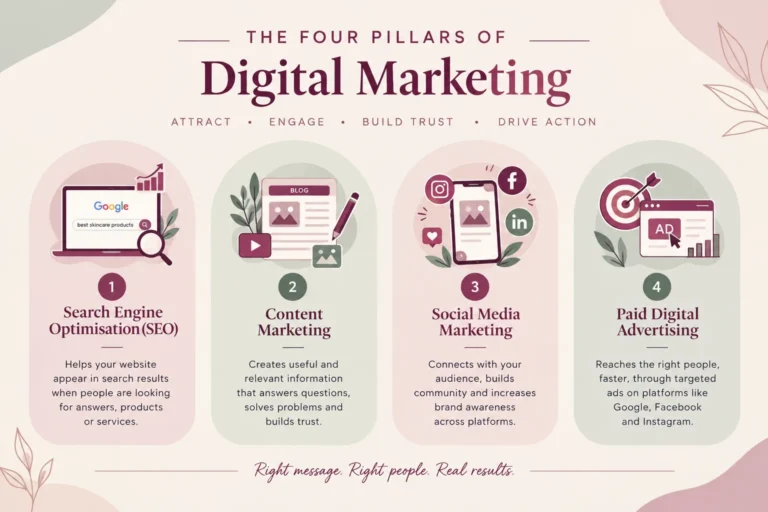
3.1 Search Engine Optimisation (SEO)
Search Engine Optimisation, commonly known as SEO, is the process of improving a website so that it appears more prominently in organic (unpaid) search engine results.
Imagine someone searches Google for “best digital marketing agency in Kerala”. If your website is properly optimised, it has a better chance of appearing when potential customers search for relevant services.
SEO generally involves:
- Keyword research: Understanding what people search for.
- On-page SEO: Optimising website content, headings, titles, and images.
- Technical SEO: Improving website speed, mobile usability, and crawlability.
- Off-page SEO: Building website authority through relevant backlinks and online mentions.
Why it matters: SEO helps businesses attract people who are already searching for their products or services.
3.2 Content Marketing
Content marketing involves creating and sharing useful, relevant, and valuable information to attract and engage a target audience.
Instead of constantly asking customers to buy something, businesses provide information that helps them make informed decisions.
Examples include:
- Blog articles and website guides.
- Educational Instagram posts and carousels.
- YouTube videos and tutorials.
- Infographics and downloadable guides.
- Case studies and customer success stories.
3.3 Social Media Marketing
Social media marketing uses platforms such as Instagram, Facebook, LinkedIn, and YouTube to promote a business, communicate with customers, and build brand awareness.
It is not simply about posting attractive pictures. Successful social media marketing requires understanding your audience and sharing content that encourages meaningful interaction.
Businesses can use social media to:
- Introduce their products and services.
- Share customer testimonials.
- Educate their audience.
- Respond to questions and feedback.
- Build relationships and brand loyalty.
For example, a local boutique can use Instagram Reels to showcase new collections and Facebook to connect with customers in its neighbourhood.
3.4 Paid Digital Advertising (PPC)
Paid digital advertising involves paying platforms such as Google, Facebook, and Instagram to display advertisements to selected audiences.
Pay-Per-Click (PPC) is a common advertising model in which advertisers pay when a person clicks on their advertisement.
For example, a business selling handmade jewellery can run an Instagram campaign targeting women interested in fashion and accessories.
Common forms of paid advertising include:
- Google Search Ads.
- Display advertising.
- Facebook and Instagram Ads.
- YouTube Ads.
- Shopping advertisements.
Why it matters: Paid advertising can help businesses reach potential customers quickly, generate enquiries, and promote specific products or offers.
- Why Is Digital Marketing Important for Businesses?
Digital marketing is no longer limited to large companies with substantial advertising budgets. Small businesses, startups, freelancers, and established brands can all benefit from it.
Here are some important advantages:
- Wider reach: Businesses can connect with customers beyond their immediate geographical location.
- Cost-effective marketing: Companies can start with relatively small budgets and increase spending based on performance.
- Measurable results: Tools such as Google Analytics help businesses understand website traffic and user behaviour.
- Improved brand visibility: Consistent online activity helps businesses establish recognition and credibility.
- How Does Digital Marketing Work?
Digital marketing works best when different channels support one another rather than operate independently.
Consider a small business selling organic skincare products.
A potential customer might discover the brand through an Instagram Reel, visit its website, read a blog about skincare ingredients, sign up for its newsletter, and eventually purchase a product.
The process could look like this:
- Attract: Use SEO, social media, and advertisements to reach potential customers.
- Engage: Share useful content that answers their questions.
- Convert: Make it easy for interested visitors to enquire or purchase.
- Retain: Use email marketing and customer communication to encourage repeat purchases.
This is a simplified example of how businesses guide customers through the buying journey.
Conclusion: Start Building Your Digital Presence
Digital marketing is about much more than posting on social media or running online advertisements. It is about understanding customers, delivering relevant information, building trust, and creating meaningful connections through digital channels.
From SEO and content marketing to social media and paid advertising, each channel plays a role in helping businesses reach their marketing goals.
For small businesses, the opportunity is significant. You do not need a massive marketing budget to begin. You need a clear understanding of your audience, a suitable strategy, and the willingness to keep learning.
FAQ's
Can small businesses benefit from digital marketing?
Absolutely! Digital marketing allows small businesses to promote their products and services without requiring a large advertising budget. They can start with a website, Google Business Profile, social media accounts and SEO to gradually build their online presence.
Is digital marketing expensive for beginners?
Not necessarily. Beginners and small businesses can start with free or low-cost activities such as creating social media content, writing blogs, improving website SEO and setting up a Google Business Profile. Paid advertising can be introduced as the business grows and its budget allows.
How does digital marketing help businesses attract customers?
Digital marketing helps businesses attract customers by making their products and services visible online. Through SEO, helpful content, social media engagement and targeted advertisements, businesses can reach potential customers, build trust and encourage enquiries or purchases.
About the Author
Leena George | Digital Marketing Enthusiast | Aveora Digital
Leena is a digital marketing enthusiast with a passion for SEO, content strategy and digital growth. Through Aveora Digital, she explores practical digital marketing techniques and shares easy-to-understand insights to help individuals and businesses strengthen their online presence.
Her approach combines creativity, data-driven thinking and a strong interest in helping businesses connect with the right audience online.
Connect with Aveora Digital to explore more about digital marketing, SEO and online growth.
Ready to Grow Your Brand Online?
As an aspiring digital marketer, I specialize in SEO audits, social media strategies, and content planning. Let’s collaborate to elevate your brand!.