
The Billboard vs. The Magnet: A Simple Lesson in Digital Marketing
Introduction: Are You Shouting or Attracting Customers?
Imagine driving down a busy highway and spotting a massive, colourful billboard advertising a luxury car. You glance at it for two seconds and continue your journey. A few minutes later, you have probably forgotten all about it.
Now, imagine a different situation. You are sitting at home when your kitchen tap starts leaking. You immediately pick up your phone, open Google and search for “How to fix a leaking kitchen tap.”
A local plumber’s website appears with a helpful video explaining how to fix the problem. Below the video, you see a simple message: “Need professional help? Call us today!”
You click the button, contact the plumber and get the problem fixed.
The first example is traditional marketing. The second is digital marketing.
Both approaches aim to promote a product or service, but they work in very different ways. One tries to get everyone’s attention, while the other focuses on reaching people who are already looking for a solution.
Let’s explore this difference through a simple analogy: The Billboard vs. The Magnet.
Table of Contents
- What Is Traditional Marketing? The Billboard Approach.
Traditional marketing is a way of promoting products and services through offline channels. It generally involves broadcasting a marketing message to a large audience, hoping that some people will become interested.
Imagine a billboard on a busy highway. Thousands of people may see it every day, but not everyone passing by is a potential customer.
Other common examples of traditional marketing include:
- Newspaper and magazine advertisements.
- Television and radio commercials.
- Flyers and brochures.
- Outdoor banners and hoardings.
- Direct mail campaigns.
The biggest challenge: Traditional marketing often reaches people who may not need or want the advertised product at that particular moment.
For example, a luxury car advertisement may reach students, people who don’t drive or individuals who cannot afford the vehicle.
The advertisement gets visibility, but visibility does not always translate into sales.
- What Is Digital Marketing? The Magnet Approach
Digital marketing is a way to promote products and services using the internet and digital platforms.
Unlike the billboard approach, digital marketing can connect businesses with people who are actively searching for information, products or solutions.
Remember our leaking kitchen tap example?
The customer had a problem and searched online for a solution. The plumber’s website provided useful information at exactly the right moment.
This is the power of digital marketing.
Some common examples include:
- Search Engine Optimisation (SEO): Helping websites appear in Google search results.
- Social Media Marketing: Connecting with customers through platforms such as Instagram, Facebook and LinkedIn.
- Content Marketing: Sharing useful blogs, videos, guides and educational content.
- Email Marketing: Building relationships through relevant emails and updates.
- Paid Digital Advertising: Showing advertisements to selected audiences through platforms such as Google and Meta.
The goal is not simply to make people notice a business. It is to build awareness, provide value, develop trust and encourage customers to take action.
- Shouting vs. Attracting: Understanding the Difference
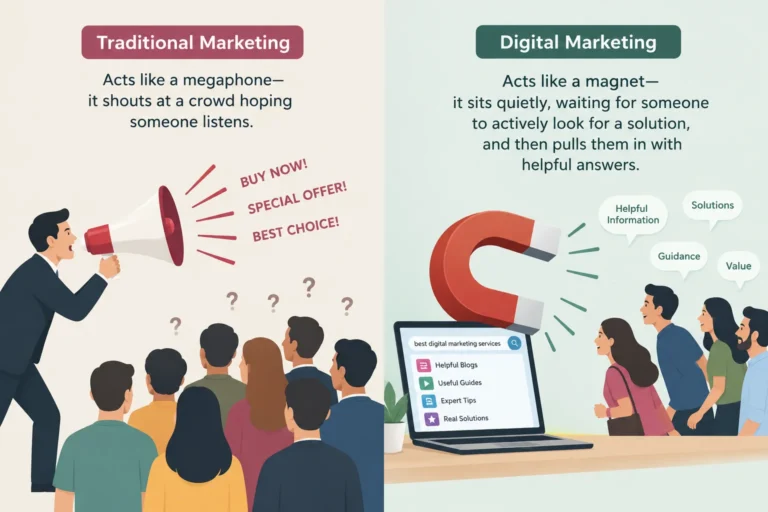
Let’s compare these two approaches using a simple example.
Imagine you own a bakery.
The traditional marketing approach:
You put up a large billboard advertising your chocolate cake. Hundreds of people see it while travelling, but most may not be interested in buying a cake that day.
The digital marketing approach:
Someone searches Google for “Best chocolate cake near me.” Your bakery appears in the search results, showing attractive cake photographs, customer reviews, prices and contact details.
The person visits your website or calls your bakery and places an order.
The difference is simple: one approach interrupts people, while the other helps people find what they are already looking for.
Traditional Marketing vs. Digital Marketing
| Traditional Marketing | Digital Marketing |
|---|---|
|
Uses offline channels |
Uses online platforms |
|
Often targets a broad audience |
Can target specific audiences |
|
Primarily pushes promotional messages |
Can attract customers through valuable content |
|
Measuring results can be difficult |
Offers detailed performance |
|
Often requires higher upfront investment |
Can start with relatively small budgets |
|
Communication is often one-way |
Supports two-way interaction |
- How Does Digital Marketing Attract Customers?
The magnet approach works through several interconnected digital marketing activities. Let’s understand the four important pillars.
4.1 Search Engine Optimisation (SEO)
SEO improves your website’s visibility on search engines, helping people find it when they look for relevant information, products or services.
For example, if someone searches for “Best skincare tips for dry skin,” a well-optimised skincare website may appear in the search results.
Search engine optimisation allows businesses to reach potential customers who are actively looking for their products or services.
4.2 Content Marketing
Content marketing is about creating useful and relevant information that answers customer questions.
Examples include:
- Educational blog articles.
- How-to videos and tutorials.
- Infographics and downloadable guides.
- Helpful social media posts.
Instead of constantly asking people to buy something, businesses build trust by providing useful information.
4.3 Social Media Marketing
Social media channels allow businesses to engage with their target audience, build relationships and share information about their products and services..
A bakery, for example, can share cake photographs, customer testimonials, behind-the-scenes videos and special offers on Instagram and Facebook.
They aim to connect with prospective customers more quickly.
4.4 Paid Digital Advertising
Sometimes businesses don’t want to wait for organic visibility. They aim to connect with prospective customers more quickly.
Paid advertising allows businesses to promote their products and services through platforms such as Google Ads, Facebook and Instagram.
Businesses can select audiences based on factors such as location, interests and demographics.
4.5 Does Traditional Marketing Still Matter?
Absolutely! Traditional marketing has not disappeared. Billboards, television advertisements, newspapers and radio commercials still play an important role in building brand awareness.
For example, a new shopping mall may use outdoor advertising to create awareness among thousands of people in a city.
At the same time, it can use Google Ads, social media and its website to attract people who want to know more about the mall.
In fact, integrating offline and online marketing methods can help businesses develop a more effective marketing strategy..
The important thing is to choose the right marketing channel based on the business objective, target audience and available budget.
Conclusion: Stop Shouting, Start Attracting
The billboard and magnet analogy teaches us one of the simplest lessons in digital marketing.
Traditional marketing often focuses on reaching a large audience and getting noticed. Digital marketing provides opportunities to reach the right audience, answer their questions and build meaningful relationships.
Successful digital marketing is not about tricking people into buying something they don’t need. It is about understanding customer problems and providing the right solutions at the right time.
Whether you are a small business owner, an entrepreneur or someone learning digital marketing, remember this:
Don’t just shout your message to the world. Give people a reason to find you.
That’s the power of digital marketing!
FAQ's
What are the four pillars of digital marketing?
The four main pillars are Search Engine Optimisation (SEO), Content Marketing, Social Media Marketing and Paid Digital Advertising.
Can small businesses benefit from digital marketing?
Yes! Digital marketing helps small businesses reach potential customers, build brand awareness and generate enquiries without requiring a large marketing budget.
Is digital marketing better than traditional marketing?
Both have their advantages. Digital marketing offers better targeting and measurable results, while traditional marketing can be effective for reaching larger audiences. The best approach depends on business goals and target customers.
About the Author
Leena George | Digital Marketing Enthusiast | Aveora Digital
Leena is a digital marketing enthusiast with a passion for SEO, content strategy and digital growth. Through Aveora Digital, she explores practical digital marketing techniques and shares easy-to-understand insights to help individuals and businesses strengthen their online presence.
Her approach combines creativity, data-driven thinking and a strong interest in helping businesses connect with the right audience online.
Connect with Aveora Digital to explore more about digital marketing, SEO and online growth.
Ready to Explore the World of Digital Marketing?
At Aveora Digital, we believe that effective digital marketing starts with understanding people, creating meaningful content and building a strong online presence.
Explore our website to discover more beginner-friendly digital marketing insights, strategies and resources.