
What is SEO? A Beginner's Guide to Search Engine Optimisation
Learn what SEO is, how search engines work, and discover simple SEO techniques to improve your website’s Google rankings.
Introduction: Imagine Having a Shop That Nobody Can Find!
Imagine opening a beautiful shop in a busy city, stocking excellent products and offering great prices. But there is one problem: nobody knows your shop exists. That is exactly what happens when you create a website without SEO.
You may have the best website, products or services, but if people cannot find you on Google, you could be missing valuable opportunities. This is where Search Engine Optimisation (SEO) comes in. In this beginner-friendly guide, we will explore what SEO is, how it works and how you can use simple SEO techniques to help your website attract more visitors.
Table of Contents
- What Is SEO?
SEO stands for Search Engine Optimisation. It involves making improvements to your website so that search engines like Google can easily understand your content and display it to users looking for relevant information.
In simple terms, SEO helps your website appear when someone searches for products, services or answers related to your business.
For example, imagine someone searches Google for “best digital marketing agency in Kerala”. If your website provides relevant information and is properly optimised, it has a better chance of appearing in the search results.
The advantage? With organic SEO, you can attract visitors to your website without paying for each click, unlike paid advertisements.
Think of SEO as making your shop easy to find on the internet.
- How Do Search Engines Work?
Have you ever wondered how Google finds millions of websites and displays relevant results within seconds?
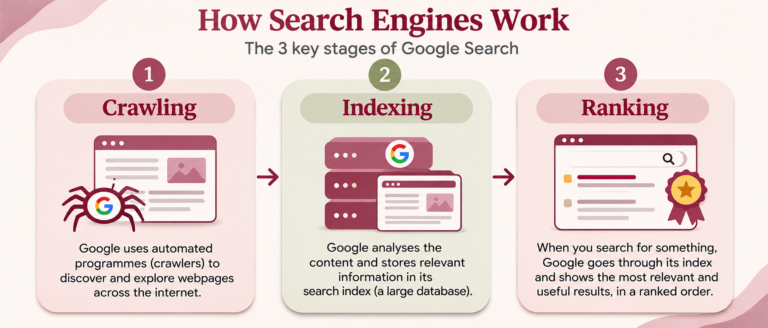
Search engines generally follow three important steps:
2.1 Crawling
Search engines use automated programmes called crawlers or spiders to discover websites and explore their pages.
Think of them as digital visitors who travel from one webpage to another, following links to discover new content.
2.2 Indexing
After discovering a webpage, Google analyses its content, images, videos and other information.
If the page is suitable for indexing, Google stores information about it in its search index, a huge database of webpages.
2.3 Ranking
When someone enters a search query, Google searches its index and displays relevant results in an order determined by many ranking systems and signals.
These systems consider factors such as relevance, content quality, usability, page experience and many other signals.
Remember: Getting indexed does not guarantee a high ranking. Your content must also be useful, relevant and accessible to your audience.
- The Three Main Pillars of SEO
SEO involves much more than simply using keywords on your website. It involves several activities that work together to improve your online visibility.
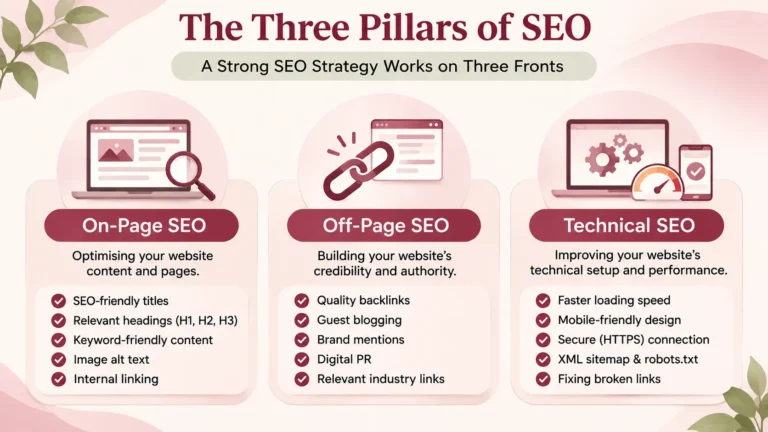
Let’s understand its three main pillars.
3.1 On-Page SEO
On-page SEO involves optimising the elements within your website to help search engines and visitors understand your content.
For example, when writing a blog about digital marketing, you should include relevant keywords naturally in your title, headings and content.
Important on-page SEO elements include:
- SEO-friendly page titles.
- Relevant headings (H1, H2 and H3).
- Meta descriptions.
- Naturally placed keywords.
- Descriptive image alt text.
- Internal links between related pages.
- High-quality, useful content.
3.2 Off-Page SEO
Off-page SEO means activities done outside your website to improve its reputation and build trust with search engines.
One important example is backlinks.
A backlink is a link from another website pointing visitors to your website.
When a relevant and trustworthy website links to your content, it can help search engines understand that your website offers useful information.
Other off-page activities include:
- Guest blogging.
- Digital PR.
- Building brand mentions.
- Earning relevant industry links.
- Developing relationships with other businesses.
Remember, quality and relevance matter more than simply collecting a large number of backlinks.
3.3 Technical SEO
Technical SEO focuses on improving the technical structure of your website so that search engines can crawl, understand and index it effectively.
Imagine having a beautiful shop with a locked entrance or confusing pathways. Customers may struggle to enter and find what they need.
Technical SEO makes your website easier to access and navigate. Technical SEO helps your website work smoothly, load properly and makes it easier for visitors and search engines to use.
Some important technical SEO elements are:
- Website loading speed.
- Mobile-friendly design.
- Secure HTTPS connection.
- XML sitemap.
- txt configuration.
- Fixing broken links.
- Proper website structure.
- Avoiding duplicate content issues.
- How Does Keyword Research Work?
Imagine you own a bakery in Kochi. You want customers to find your website when they search for cakes online.
But what exactly are they typing into Google?
Some people may search for “best bakery in Kochi”, while others may type “birthday cakes near me” or “customised cakes in Kochi”.
These search terms are called keywords.
Keyword research is the process of identifying the words and phrases your target audience uses when searching online.
Types of Keywords
- Short-tail keywords
These are broad search terms, usually containing one or two words.
Examples: SEO, digital marketing, skincare.
- Long-tail keywords
These are more specific search phrases, often containing three or more words.
Examples:
- SEO tips for small businesses.
- How to improve website ranking on Google.
- Best digital marketing strategies for beginners.
Long-tail keywords can help you attract visitors with more specific search intentions.
Popular Keyword Research Tools
- Google Keyword Planner.
- Google Trends.
- Google Search Console.
- Ubersuggest
- Ahrefs
- Semrush
As a beginner, you can start with Google Search suggestions and Google Keyword Planner before investing in paid SEO tools.
- Simple SEO Tips for Beginners
You do not need to be a technical expert to start improving your website’s SEO.
Here are seven practical steps you can follow:
- Understand your audience: Identify what your potential customers are searching for.
- Select suitable keywords: Use search terms that are relevant to your content and what your target audience is looking for.
- Create useful content: Write informative blogs that answer real questions.
- Optimise your Page titles: Add your primary keyword naturally in your page title.
- Use internal links: Connect related blogs and service pages on your website.
- Make your website mobile-friendly: Ensure visitors can easily browse your website on smartphones.
- Track your performance: Use Google Search Console to check how your website is performing in Google search results.
SEO is not about tricking Google. It is about creating a better experience for people searching for information.
Conclusion: SEO is an Investment in Your Online Visibility
SEO is an important digital marketing strategy that helps businesses establish a strong online presence over time.
From understanding how search engines work to researching keywords and improving website performance, every SEO activity contributes towards making your website more discoverable.
Begin by learning the fundamentals, publishing helpful content and making gradual improvements to your website.
Even the best website needs visibility to reach the right audience. SEO helps make that possible!
FAQ's
Is SEO free?
Organic SEO does not require payment to Google for clicks or rankings. However, you may spend money on SEO tools, content creation, website development or professional SEO services.
Can I learn SEO without coding?
Yes! You can learn many SEO fundamentals without coding knowledge. Keyword research, content optimisation, title tags, meta descriptions and internal linking are good starting points. Technical SEO may require some additional technical understanding.
Which SEO tool should a beginner use?
Google Search Console and Google Keyword Planner are excellent starting points. They help you understand search performance and identify relevant keyword opportunities
About the Author
Leena George | Digital Marketing Enthusiast | Aveora Digital
Leena is a digital marketing enthusiast with a passion for SEO, content strategy and digital growth. Through Aveora Digital, she explores practical digital marketing techniques and shares easy-to-understand insights to help individuals and businesses strengthen their online presence.
Her approach combines creativity, data-driven thinking and a strong interest in helping businesses connect with the right audience online.
Connect with Aveora Digital to explore more about digital marketing, SEO and online growth.
Ready to Explore the World of Digital Marketing?
At Aveora Digital, we believe that effective digital marketing starts with understanding people, creating meaningful content and building a strong online presence.
Explore our website to discover more beginner-friendly digital marketing insights, strategies and resources.